viernes, 1 de marzo de 2019

Circuits

CIRCUITS
  • An electrical circuit is a closed circuit whose purpose is to take electrical energy from elements that produce it to other elements that consume it.
  • The electric current is a movement of electrons, therefore, any circuit must allow the passage of electrons by the elements that compose it.

ELEMENTS
  • CONDUCTROS: is where the electric current moves from one element to another circuit. They are made of copper or aluminum, good conductors of electricity, or what is the same as they offer very little electrical resistance to the current passing through them.
  • RECEPTORS: are the elements that transform the electrical energy that reaches them in another type of energy. For example, light bulbs transform electrical energy into light or light, radiators into heat, motors into motion, etc.
  •  ELEMENTS OF COMAND AND CONTROL: allow direct or cut at will the passage of electric current within the circuit. We have switches, push buttons, switches, etc.
  • PROTECTION ELEMENTS: protect the circuits and people when there is danger or the current is very high and there may be a risk of burning the elements of the circuit. We have fuses, thermal magnets, differentials, etc.
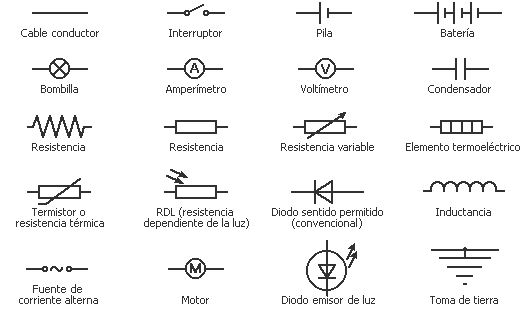
simbolos circuitos electricos


KINDS OF CIRCUITS

  • SERIES CIRCUITS. They are those in which the resistances are placed one behind the other so that the end of each resistance is connected to the beginning of the next (we call the beginning of an R to the place where the resistance arrives and the end to the point by the one that comes out) and so on. In this type of connection, all the receivers are traveled by the same current, the voltage of the generator is distributed among the receivers and, as a peculiarity, has the disadvantage that when one of the receivers stops working, due to breakdown or disconnection, it leaves to operate the entire circuit.
  • PARALLEL CIRCUITS. They are those in which the principles of the resistances are linked together by a cable, and the ends of the resistances are also linked by another cable. In this case all receivers are subjected to the same voltage and is the most frequent type of connection, which we have at home.
  • MIXED CIRCUITS. They are resolved as a combination of the two previous cases.

Resultado de imagen de CIRCUITO MIXTO PARALELO Y SERIE


+

jueves, 28 de febrero de 2019

How to solve a circuit

How we calculate V,R and I in the following circuits?
  • Rt, It, V1, V2 and V3 ?
  1. Rt= R1+R2+R3 >> Rt= 10+20+30= 60Ω
  2. It= Vt: Rt >> It= 180: 60= 3A
  3. V1= R1x It>>V1= 10x3= 30v
  4. V2= R2x It>>V2= 20x3= 60v
  5. V3= R3x It>>V3= 30x3= 90v


  • Rt, It, I1, I2 and I3 ?
  1. Rt= 1:[(1:R1)+(1:R2)+(1:R3)]>> Rt= 1:[(1:15)+(1:5)+(1:10)]= 2.72Ω
  2. It= Vt: Rt>> It=5: 2.72= 1.83A
  3. I1= Vt: R1>> I1=5: 15= 0.33A
  4. I2= Vt: R2>> I2=5: 5= 1A
  5. I3= Vt: R3>> I3=5: 10= 0.5A


  • Rt, Rtp, It, I1,I2,I3,I4 ?
  1. Rtp= 1:[(1:R1)+(1:R2)+(1:R3)]>>                                          Rtp={1:[(1:3)+(1:6)+(1:3)]}=1.2Ω
  2. Rt=R4+Rtp>> Rt=2+1.2=3.2Ω
  3. It=Vt: Rt>> It=9: 3.2=2.8A
  4. I1= Vt: R1>> I1=9: 3= 3A
  5. I2= Vt: R2>> I2=9: 6=1.5A
  6. I3= Vt: R3>>I3=9:3= 3A
  7. I4=It>> I4=2.8A


Basics of electricity


WHAT IS ELECTRICITY?
  • Electricity is the physical flow of electrons, referred as an electrical current. Electricity is an energy carrier that efficiently delivers the energy found in primary sources to end users, who convert it into energy services.

ELECTRIC CURRENT (I)
  • Is the magnitude of an electric current measured by the quantity of electricity crossing a specified area of equipotential surface per unit time. 
  • It is measure in Amperes (A).

VOLTAGE (V)
  • The voltage, voltage or potential difference is the pressure exerted by a source of electrical power or electromotive force on electric charges or electrons in a closed electrical circuit, to establish the flow of an electric current.
  • A greater potential difference or pressure exerted by a source on the electrical charges or electrons contained in a conductor, the greater the voltage or voltage in the circuit to which that conductor corresponds.
  • It is measure in volts (v).

RESISTANCE (R)
  • It is called electrical resistance, the difficulty or opposition of a body to the passage of an electric current to circulate through it.
  • It is measure in ohms (Ω).
OHM`S LAW

  • Georg Ohm found that, at a constant temperature, the electrical current flowing through a fixed linear resistance is directly proportional to the voltage applied across it, and also inversely proportional to the resistance. This relationship between the Voltage, Current and Resistance forms the basis of Ohm`s law.
  1. To find the Voltage, ( V ) >> [ V = I x R ]   
  2. To find the Current, ( I ) >> [ I = V ÷ R ]     
  3. To find the Resistance, ( R ) >> [ R = V ÷ I ]     Resultado de imagen de ohm's law